
20/8/2026
The fire resistance of building components is a critical aspect of modern construction, directly impacting life safety and property protection. For specialized elements such as floor hatches, the assessment of fire performance presents unique challenges, often leading to questions among manufacturers regarding applicable standards and testing methodologies.
This article addresses these complexities, focusing on the difficulty to assess the performance of a floor hatch and the interplay between European and Australian standards.
The Challenge of Horizontal Application of EN 1634-1
In practice, regulatory requirements often demand a fire resistance classification for floor hatches in line with those established for doors and openable windows. This creates a key challenge for manufacturers, namely whether a floor hatch can be tested in accordance with EN 1634-1 [1]
This standard, titled “Fire resistance and smoke control tests for door and shutter assemblies, openable windows and elements of building hardware,” specifies testing procedures that may appear as applicable to floor hatches; however, its scope is explicitly limited to vertically oriented elements.
The direct application of EN 1634-1 to floor hatches therefore constitutes a deviation from its scope, as the fire exposure conditions and structural behaviour of horizontal elements differ significantly from those of vertical assemblies.
Nevertheless, the underlying principles of EN 1634-1 remain relevant for horizontally applied openable elements. For example, aspects such as the positioning of thermocouples and pre-conditioning procedures are intended to characterise the performance of the openable element itself, rather than being inherently dependent on its orientation. As such, these methodological principles can, to a certain extent, be extrapolated to horizontal applications such as floor hatches.
EN 1365-2 [2] is directly applicable to a floor hatch; however, it does not explicitly consider the specific performance characteristics associated with openable elements.
Classification under Delegated Act 2024/1681 and EN 13501-2
Another crucial aspect is the classification of the product in accordance with European standards, specifically EN 13501-2 [3], which establishes a classification system for construction products and building elements based on results from fire resistance and smoke control tests. For openable elements, classification typically involves the assessment of insulation (I), integrity (E) and, where relevant, radiation performance (W). However, within EN 13501-2, the product category most comparable to a floor hatch is that of shutters, for which EN 1634-1 is designated as the corresponding test method. This creates an inherent limitation, as the applicability of EN 1634-1 is restricted to vertical elements.
The question of whether a floor hatch can be classified under EN 13501-2 is therefore intrinsically linked to the availability of valid test data obtained in accordance with appropriate test methods (such as EN 1634-1 and EN 1365-2, even if combined) and to the ability to evaluate such data against the defined classification criteria. In practice, EN 13501-2 does not provide explicit criteria that can be applied independently of test methods whose scope either does not fully cover the product or requires justified deviations.
The Delegated Act 2024/1681 [4] establishes harmonized classes of performance in relation to resistance to fire for construction products. Notably, it explicitly includes roof lights and shutters within its scope and allows their classification either in line with horizontal elements (e.g. floors, including loadbearing capacity) or with openable elements (e.g. doors, including distinctions such as I₁ and I₂). In this way, the Delegated Act provides a more explicit and up-to-date framework for the classification of floor hatches.
On this basis, a classification approach that combines appropriate fire testing with the performance classes defined in Delegated Act 2024/1681, interpreted in conjunction with EN 13501-2, can be considered a technically sound and state-of-the-art solution.
Case Study by Efectis
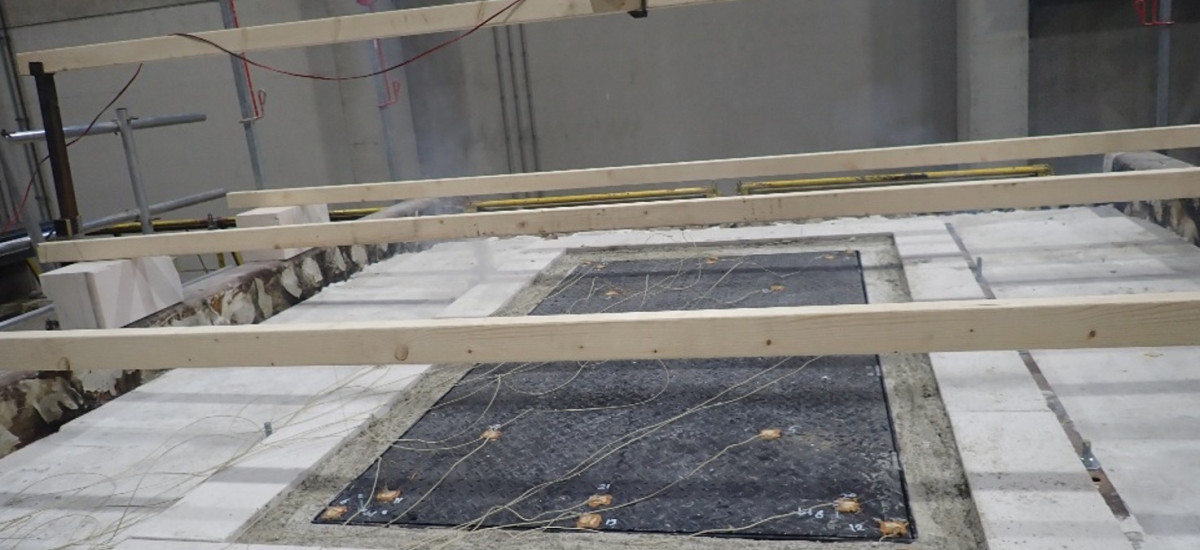
Efectis Nederland recently conducted a comprehensive fire resistance test on a floor hatch manufactured by Gorter B.V. This project successfully navigated the previously identified complexities. The test was conducted on a floor hatch, explicitly considering the challenges associated with horizontal application, and was carried out in accordance with both EN 1634-1 as EN 1365-2. The successful outcome of this test enabled classification of the floor hatch in line with the provisions of Delegated Act 2024/1681, resulting in a high level of fire resistance performance.
Integration of Australian Standard AS 1530.4:2014
Adding a further level of complexity, Efectis Nederland also incorporated additional requirements based on the Australian Standard AS 1530.4:2014 [5], titled “Methods for fire tests on building materials, components and structures – Fire-resistance tests for elements of construction”.
This required the integration of specific measurement methodologies, including the placement of additional thermocouples and the execution of pre-test measurements and selection procedures in accordance with the Australian framework. The combination of European and Australian requirements within a single test programme demonstrates the ability to adapt standardised methodologies to meet differing regulatory expectations. It further highlights a comprehensive understanding of international fire testing standards and the capability to design and execute test programmes tailored to complex, multi-regulatory project requirements.
Conclusion
The successful fire resistance testing and classification of a floor hatch by Efectis Nederland demonstrates the importance of expert interpretation and rigorous execution when navigating the complexity of fire safety standards. By combining test methodologies from EN 1634‑1 and EN 1365‑2, applying classification principles in line with EN 13501‑2, and utilising the framework provided by Delegated Act 2024/1681, a technically justified and state‑of‑the‑art solution was achieved.
Furthermore, the integration of additional requirements from AS 1530.4:2014 illustrates the capability to extend beyond European regulatory frameworks and address international market needs within a single, coherent test strategy. This approach enables manufacturers to obtain robust and relevant performance data, ensuring that their products meet both regional and global fire safety requirements, providing peace of mind for regulators and end-users.
For more information, please contact: Fawzi Mishahrawi
[1] Details van EN 1634-1, titel, jaartal etc.
[2] EN 1365-2
[3] EN 13501-2
[4] Delegated act 2024/1681
[5] AS 1530.4:2014