
10/11/2026
The growth of Cloud computing and artificial intelligence is driving strong growth in data center projects in France. To ensure the business continuity required by the digital economy, these infrastructures rely on uninterruptible power supply (UPS) systems using batteries.
Lithium-ion (Li-ion) technology is pushed forward because it offers numerous advantages, particularly a high energy density. However, it poses major safety challenges:
- Safety of personnel and emergency services: Avoid exposing staff and firefighters who must intervene in a confined environment.
- Business Continuity: Prevent service interruptions, the cost of which can reach several million euros per hour.
- Financial and insurance stakes: Protect heavy capital investments (CAPEX) and meet insurer requirements.
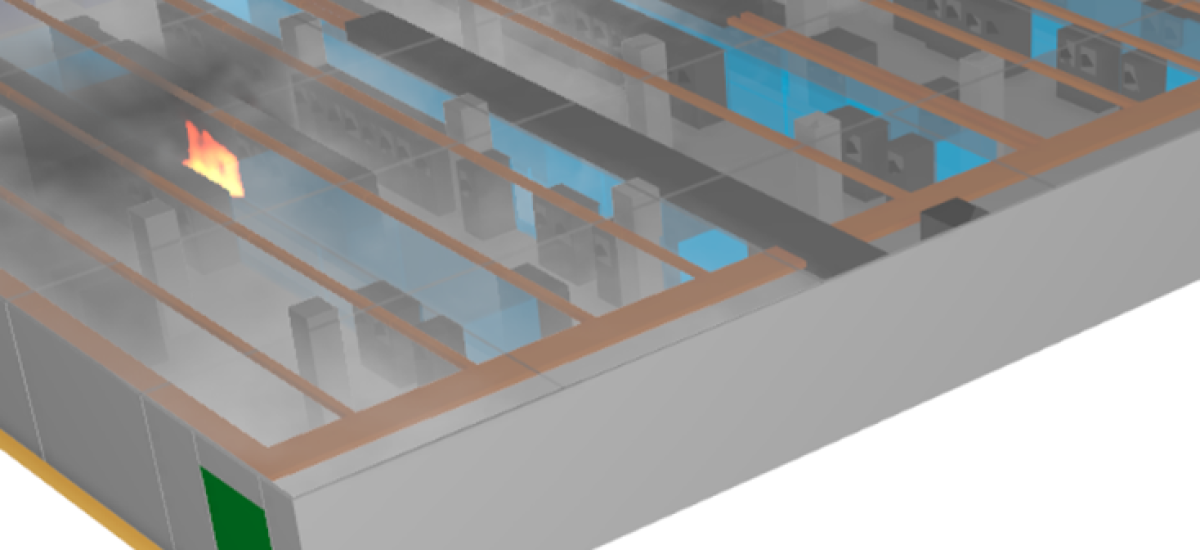
Li-ion batteries present fire and explosion risks in the event of thermal runaway[1], as they release a large quantity of toxic and reactive gases over a long period that can last several dozen hours depending on the propagation pattern and the number of batteries involved.
The main feared phenomena are:
- Dense, corrosive, and highly toxic smoke emissions (hydrogen fluoride HF, carbon monoxide, hydrogen cyanide).
- Highly directional, abrasive, high-intensity “jet flames” that can compromise the “standard” fire rating of walls.
- Gas accumulation and explosion from thermal runaway, generating high overpressure levels in confined spaces due to the high reactivity of the generated gases (Hydrogen, Carbon Monoxide, Ethylene, Methane) – despite the presence of carbon dioxide and confinement that enhance wave propagation in the building.
Fire and explosion risks are closely linked and must be addressed simultaneously to achieve a satisfactory safety level. Consequently, certain traditional fire safety solutions, such as automatic fire suppression, can adversely affect explosion safety, and vice versa for other safety barriers.
The management of battery room risks must therefore be integrated right from the early project stage (conceptual / basic design) to avoid major cost overruns and execution delays.
Given the multiplicity of applicable standards, turning to dedicated safety engineering is essential. This relies on a multi-scale (cell, module, rack, room, building) and multi-layer (prevention, detection, control, mitigation, emergency response) approach based on risk analyses lead by a multidisciplinary working group.
For more information, please contact: Laurent Paris
[1] Self-sustaining exothermic reaction (triggered by a short circuit, overload, or physical impact), causing an uncontrolled temperature rise within seconds