
10/11/2026
The Challenge of Structural Penetrations – One Wall, Multiple Challenges
Data centres are divided into fire compartments to limit the spread of fire and protect critical infrastructure. Yet the buildings themselves are interconnected systems: structural elements extend across compartment boundaries, while electrical distribution systems, cable routes and pipework pass through fire-resisting walls and floors.
In one building, several challenges associated with fire compartmentation came together in a single wall. Structural movement, heat transfer through metal services and the fire resistance of busbar penetrations all had to be considered. Although each presented a different technical challenge, they shared the same underlying question: how could the fire-resisting function of the complete compartment boundary be maintained?
The distinction between structural fire resistance and compartmentation performance is essential. The R criterion addresses the load-bearing capacity of a structural element, while the E and I criteria address the integrity and insulation of a fire-separating element. However, these criteria cannot always be considered independently. Structural movement can damage a penetration seal, while heat conducted through metal services can increase temperatures on the unexposed side. Maintaining fire compartmentation therefore requires an understanding of how the wall, the structure, the services and their protective systems interact under fire conditions.
Structural Movement affects fire performance
One of the challenges in the building involved steel beams passing through fire-resistant partition walls. The walls were required to maintain their integrity and thermal insulation for 180 minutes under fire exposure from either side. As the steel beams heated up, they could deflect significantly, potentially transferring movement to the surrounding wall and compromising the penetration seal.
The key challenge was to design a penetration detail that could accommodate structural movement without compromising the fire-separating function of the wall. The proposed detail was therefore designed to accommodate 40 mm of relative movement, while maintaining the integrity and insulation of the penetration. A support positioned relatively close to the partition wall helped limit beam deflection at the point of penetration.
The assessment concluded that EI 180 performance could be expected, provided that beam deformation at the penetration remained within the 40 mm movement capacity during the 180-minute fire exposure and that the fire resistance of the partition wall itself was demonstrated.
This example illustrates how structural movement must be considered as part of the fire-stopping design. The penetration seal must not only provide the required fire resistance rating, but also accommodate the anticipated movement of the structure to maintain the performance of the compartment boundary.
Assessing Heat Transfer Through Metal Pipes
Mechanical movement was not the only concern in this wall. The thermal behaviour of penetrating services also required consideration. Metal pipes can conduct heat from the fire-exposed side to the unexposed side of a compartment boundary. Even when the opening around a pipe is adequately sealed, heat transfer along the pipe itself may cause temperatures on the protected side to rise. The insulation criterion therefore requires consideration of more than the performance of the seal immediately surrounding the penetration.
A finite element method (FEM) calculation was used to investigate heat transfer through a steel pipe in a separate penetration detail within the building. The model considered a steel pipe with a PVC casing and Armaflex insulation, exposed to the ISO 834 standard fire curve.
The calculation examined the effect of protective insulation thickness and length on temperatures along the pipe. Under the specific modelled conditions, a 50 mm steel pipe protected with 400 mm of mineral wool over a length of approximately 1,310 mm reached a calculated temperature of around 30°C after 180 minutes. Increasing the protection length to 1,800 mm resulted in a calculated temperature of around 20°C.
These values demonstrate how numerical modelling can help investigate heat transfer and compare potential design solutions. They are, however, results for the specific geometry, materials, boundary conditions and fire exposure used in the calculation. The assessment also considered other potential failure mechanisms. For example, PVC may soften or melt when heated, while damage to the pipe or its supports could affect the penetration seal. Additional protective measures and mechanical provisions were therefore considered as part of the overall detail.
Importantly, a thermal FEM calculation does not by itself demonstrate the integrity of a penetration seal, its mechanical stability or the fire resistance classification of the complete assembly. Those aspects require appropriate supporting evidence and assessment. Numerical modelling is valuable for understanding thermal behaviour, but it must be used within the limits of what it can establish.
When Part of the Fire-Resisting Wall Is Expected to Fail
The challenge becomes more complex when the fire strategy anticipates that part of a separating construction may fail during a fire. In this particular building involving a separation formed by multiple wall elements, the design concept allowed the fire-exposed element to collapse while the remaining separation was expected to continue performing its function.
This scenario introduced several potential failure mechanisms for penetrations passing through the construction. The collapse of one wall element could damage pipework, displace a penetration seal or impose loads on the remaining wall. Even if the opening remained sealed, heat could be conducted through a metal pipe into the adjacent compartment. Combustible components, such as polymeric pipe casings or insulation, could also melt, degrade or provide a route for fire spread.
These mechanisms cannot be assessed independently of the fire strategy. A penetration that performs adequately in a stable wall may behave differently if the surrounding construction moves or collapses. The design must consider whether the service, its supports and the penetration seal can withstand the expected consequences of that failure.
In the case assessed, the proposed approach combined thermal insulation with additional fire-stopping measures intended to maintain the seal if combustible components degraded. Measures to reduce the risk of mechanical damage to the pipework were also considered.
The broader lesson is that the performance of a penetration must be evaluated in the context of the complete compartmentation concept. Where structural failure or significant movement is anticipated, it is not sufficient to demonstrate only that the sealing materials can withstand a standard fire exposure.
Busbar Penetrations: From Engineering Assessment to FM Approval
The busbar penetrations brought the different aspects of the project together. Busbars are essential components of a data centre’s power distribution system, and their size and construction can make it challenging to maintain fire compartmentation where they pass through walls.
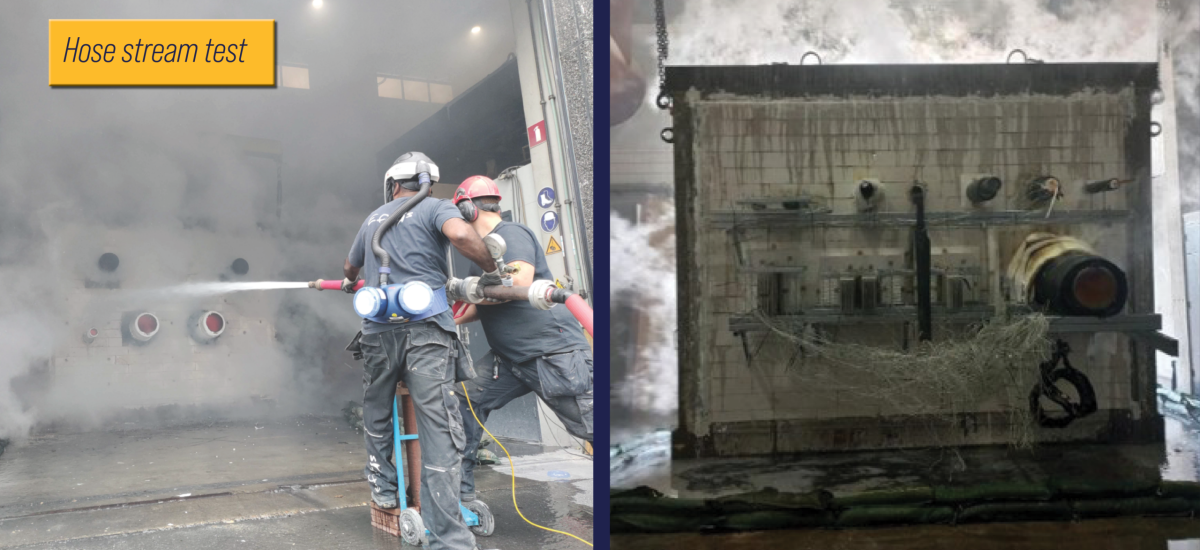
The required level of performance may also exceed the minimum statutory requirements. In this case, the insurer required the busbar penetrations to obtain FM Approval. Meeting this requirement meant demonstrating the performance of the complete penetration arrangement, rather than relying solely on an engineering assessment or the properties of individual fire-stopping materials. A full-scale fire test was therefore carried out on three configurations: a single 3,200 A busbar unit, a single 2,500 A unit and two 2,500 A units installed side by side.
The fire resistance test examined the complete penetration assembly exposed to the standard heating curve in accordance with EN 1363-1. The subsequent hose-stream test based on ASTM E2226 subjected the assembly to a pressurised water stream, providing an additional assessment of its response to the mechanical effects of water impact following heating. The investigation included several busbar configurations, installed side by side. The tested assemblies combined fire-stopping materials, protective collars, mortar and layered stone wool boards. During fire exposure, observations included deformation of services, movement and tearing of insulation, smoke leakage and cracking in mortar.
These observations underline why performance cannot be inferred from the properties of individual materials alone. The interaction between the busbar, the sealing system, the supporting construction and the surrounding wall determines how the assembly behaves under fire conditions. Following successful testing and evaluation, the penetration solution received FM Approval.
This outcome demonstrates how engineering assessment and testing can serve complementary purposes. Engineering can help identify risks, investigate potential solutions and develop suitable details. Where a formal approval is required, testing and evaluation provide evidence that the defined assembly meets the applicable requirements.
Demonstrating the Performance of the Complete Wall
The challenges encountered in this building show why fire compartmentation must be considered as a system.
Structural movement can place mechanical demands on penetration seals. Metal services can conduct heat beyond the fire-exposed side. Changes in materials, wall construction, service arrangement or installation details can affect whether existing test evidence is applicable. Where the fire strategy also accounts for structural failure, the possible consequences for the remaining compartment boundary must be considered as well.
No single method can answer every question. Engineering assessment helps establish how a proposed detail is expected to behave. Thermal modelling can quantify heat transfer under defined conditions. Fire testing provides evidence of the performance of a specific assembly, while formal approval may be required to demonstrate compliance with additional project or insurance requirements.
The key is to understand both the limitations and the contribution of each method, and to ensure that the evidence supports the configuration actually being installed.
In data centres, maintaining fire compartmentation is not simply a matter of sealing openings in a wall. It requires understanding how the structure, services and penetration seals interact under fire conditions, and demonstrating that the complete solution can maintain the required level of performance.
For more information, please contact: Cindy Beckers